Wild Type vs. Melanoid Axolotls: Genetics, Appearance & Care | LLAR
They're both dark. They're both beautiful. And at a quick glance—especially in low light or on a phone screen—a Melanoid axolotl and a dark Wild Type can look remarkably similar. But genetically, they are as different as two axolotls can be, and knowing the difference can matter when you're looking to understand the animal in your care. Let's break it down.
Wild Type: The Genetic Original
The Wild Type is not simply a "natural" axolotl—it's the genetically dominant expression of axolotl pigmentation, the baseline from which all other morphs are derived through recessive mutations. A true Wild Type axolotl carries the dominant allele at all the major morph loci: it is heterozygous or homozygous dominant for the dark gene (D), and carries wild-type alleles at both the albino (a) and melanoid (m) loci.
In practice, Wild Type axolotls display:
Olive-to-dark-brown mottled body coloration, often with darker spotting or irregular patterning
Gold-flecked irises—one of the most reliable visual ID clues for Wild Type
Visible iridescent shimmer across the skin—especially visible under tank lighting—produced by active iridophores
Dark gills with good coloration, often showing reddish-pink internal gill branches
All three chromatophore types—melanophores (dark pigment), xanthophores (yellow/gold pigment), and iridophores (reflective light-scattering cells)—are active and expressed in Wild Type animals. This is what creates the complex, layered coloration that makes Wild Types so visually interesting up close, even if they don't have the dramatic pop of rarer morphs.
Melanoid: All Dark, Zero Shine
The Melanoid morph results from a recessive mutation at the melanoid locus: an axolotl must carry two copies of the recessive melanoid allele (m/m genotype) to express the Melanoid phenotype. This genotype has two simultaneous effects: it significantly increases melanophore density, and it completely suppresses iridophores.
That suppression of iridophores is the defining characteristic of the Melanoid morph—and it is the single most reliable visual ID clue. Melanoid axolotls display:
Deep charcoal, dark grey, or near-black body coloration—sometimes appearing almost blue-black in certain lighting
Completely matte, non-reflective skin texture—no metallic sheen, no shimmer, no glint
Very dark eyes with no gold speckling
Dark gills, often appearing very dark red to brownish-black
The velvety, matte quality of a Melanoid is striking precisely because it's so complete. While a dark Wild Type might look similar under casual observation, close inspection under a tank light will always reveal at least some iridophore activity in a Wild Type animal. A true Melanoid has none.
Head-to-Head Comparison
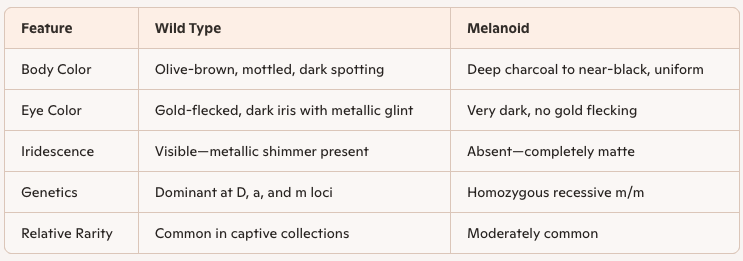
Care Notes
Good news for keepers of both morphs: Wild Type and Melanoid axolotls share identical care requirements. Both morphs thrive at cool water temperatures (ideally 60–66°F ), require good water quality with regular monitoring of ammonia, nitrite, and nitrate, and should be housed in appropriately sized tanks with adequate hiding spots and a fine sand or bare-bottom substrate.
Morph does not meaningfully affect care needs, temperature tolerance, or general hardiness in either case.
Common Misidentifications
Dark Wild Type mistaken for Melanoid: The single most common misidentification in the hobby. The fix: examine the animal closely under a bright light for any iridescent shimmer. Any sparkle at all = Wild Type. Zero shimmer = potentially Melanoid.
Melanoid mistaken for GFP Melanoid: Under normal lighting, a GFP Melanoid looks identical to a standard Melanoid. You need a blue/UV light (450–470nm) to distinguish the two. If you've adopted an animal claimed to be GFP, test with appropriate lighting to confirm.
Frequently Asked Questions
Q: How does Melanoid inheritance work?
A: Melanoid is a recessive morph, meaning an axolotl must inherit two copies of the recessive melanoid allele (m/m) to visually express it. A Wild Type axolotl may or may not carry a hidden copy of the melanoid allele. If it does not, any offspring with a Melanoid parent will all appear Wild Type—but will carry one copy of the melanoid allele. Understanding whether a Wild Type animal is a carrier helps make sense of why certain morphs appear or don't appear across generations.
Q: Do Melanoid axolotls stay dark as they age?
A: Yes. Unlike some other morphs that can shift in color intensity as juveniles mature, Melanoid coloration is generally stable across life stages, though depth of color can vary somewhat with water temperature and stress levels.
Q: Is one morph healthier than the other?
A: No. Morph does not confer any meaningful health advantage or disadvantage in properly cared-for captive axolotls. Both morphs are equally robust when kept in appropriate conditions.
📥 GET THE FREE GUIDE
The LLAR Axolotl Morph Guide covers Wild Type, Melanoid, and all five other primary morphs—plus GFP and RFP traits, myth morphs, sub-varieties, and a full genetics glossary. Written by Cora Hanlin, presented by LLAR. Fill out the short form—it's yours. → https://www.libertylandaxolotlrescue.org/axolotl-morph-guide-2026
