What Is a Firefly Axolotl and Why Is It Unethical?
This is the first in our two-part series on Firefly axolotls, published in honor of Prevention of Animal Cruelty Month, taking place April 2026.
April is Prevention of Animal Cruelty Month, and this year we decided to shed some light on a cruel and unusual practice surprisingly still going on in the axolotl industry: Firefly axolotls.
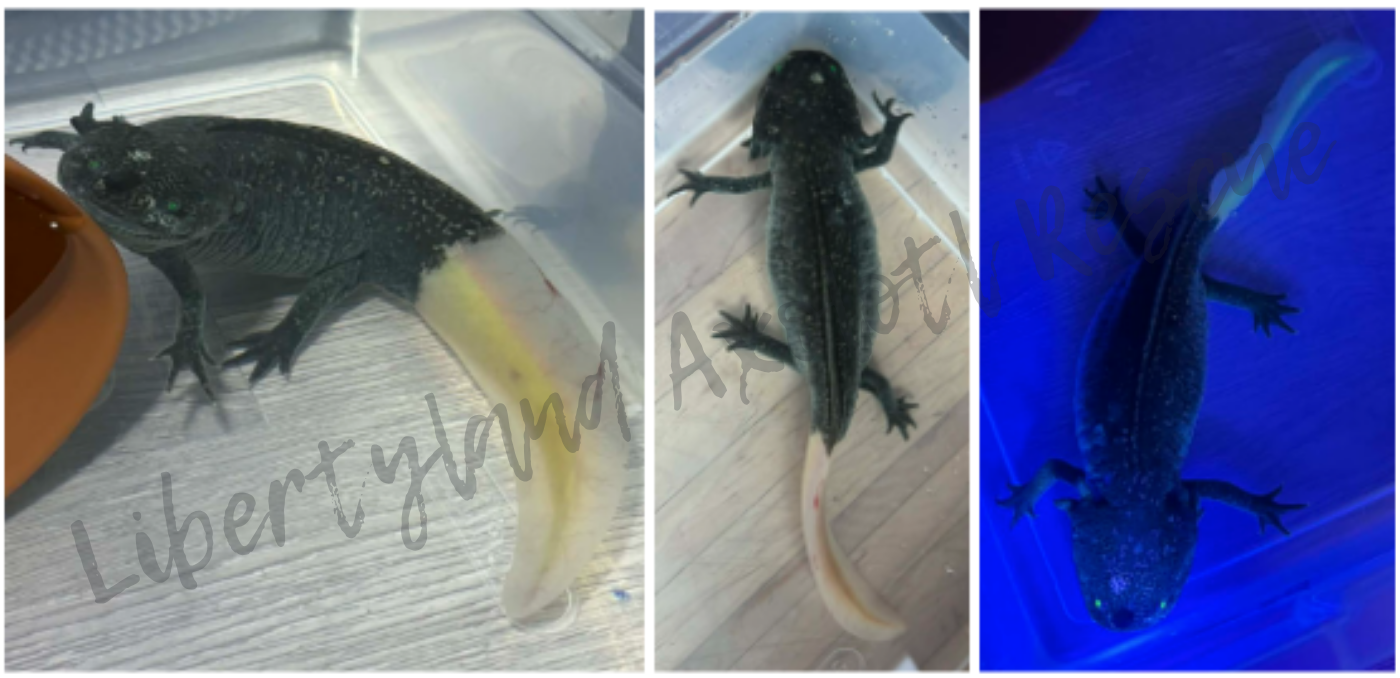
Pickles, a Firefly axolotl recently placed by Libertyland Axolotl Rescue through foster-to-adopt. Libertyland does not publicly promote surgically modified axolotls that are surrendered to us, preferring instead to use foster-to-adopt in an effort to avoid creating additional demand for this unethical type of axolotl.
Photos by LibertyLand Axolotl Rescue Foster © LLA 2026
What is a Firefly axolotl?
A Firefly axolotl is not a natural axolotl morph. It is produced by cutting away a portion of an axolotl’s tail (or other body part) and surgically attaching tissue taken from a different axolotl, creating a visual effect that is entirely cosmetic and not genetic. Traditionally, the goal is to produce a light body with a dark tail or the reverse, sometimes with one segment expressing GFP while the other does not, as seen in the photo above. To be clear, these visual patterns do not occur naturally and are the result of invasive surgical modification.

Two Candy Corn Dinosaur Firefly axolotls
Source: https://www.reddit.com/r/axolotls/comments/11ntwtb/the_ethics_of_firefly_axolotls/
Today, four variations of Firefly axolotl exist:
Firefly Axolotl. The standard “Firefly;” an axolotl created by cutting off the tail of a juvenile axolotl and surgically replacing it with the tail of another juvenile axolotl, usually of contrasting colors, to create a half-and-half look that is not natural and only available through cosmetic surgical intervention.
Candy Corn Fireflies. A candy corn Firefly is created using three grafted tail segments instead of two. This requires multiple surgical sites and increases the risk of complications.
Dinosaur Fireflies. Dinosaur Fireflies involve grafting in non traditional areas such as the dorsal fin, abdomen, or face. These procedures have been documented to cause deformities including malformed fins and in severe cases loss of eyes due to facial grafting.
Checkerboard Fireflies. Checkerboards are created by cutting the tail into square sections and grafting them in alternating patterns. This produces a multi segment checkerboard appearance.
Fireflies are not ethical to create. The procedures are cosmetic and invasive.
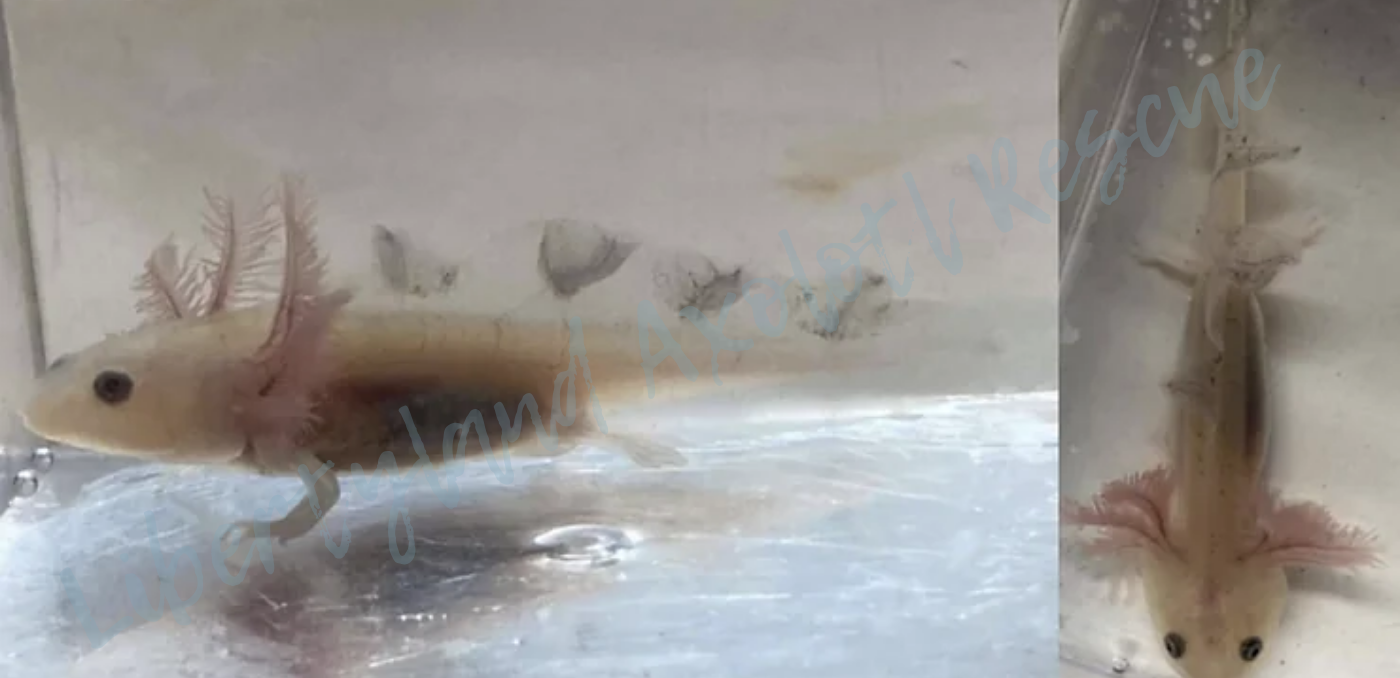
Image showing an axolotl that underwent a post-embryonic eye-swap surgery, a procedure with a known high rate of failure. Original source: https://www.facebook.com/BeautifuLotls
Where (and how) Fireflies originated
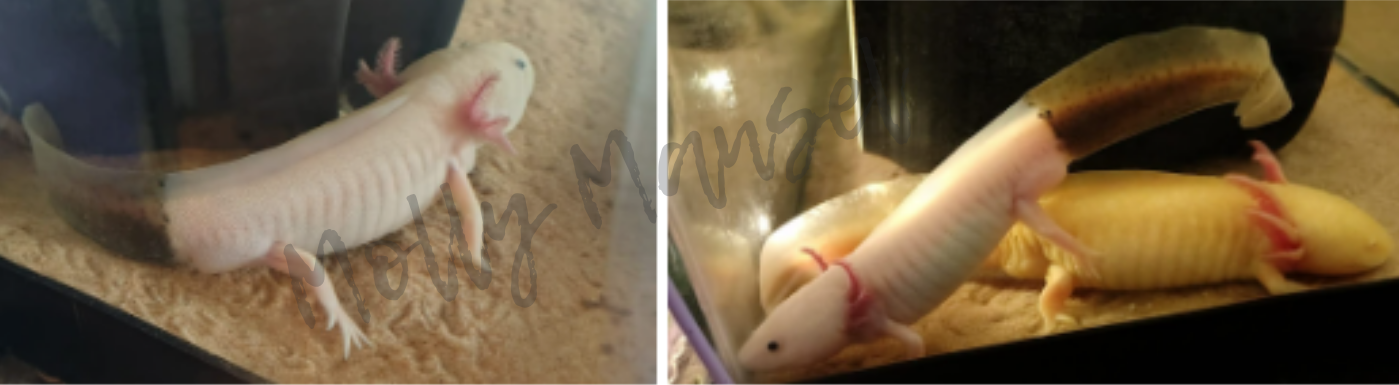
Photos by Molly Mansel ©2026
The first Fireflies were created by Lloyd Strohl II as part of a controlled melanocyte research project. His work used embryonic grafting, a method that involves transferring tissue between embryos before pain receptors develop. At this early developmental stage, axolotl embryos do not yet have the neural structures required to perceive pain.
Strohl’s process involved several steps:
A small portion of tail tissue was removed from one embryo.
That tissue was transferred into another embryo during early development.
The embryo continued developing inside the egg, allowing the graft to integrate naturally.
The purpose of this work was scientific. Strohl was studying pigment cell behavior and developmental pathways, not creating animals for sale. Once his research questions were answered, he discontinued the work. He did not promote Fireflies as morphs and did not continue producing them for the hobby.
This original embryonic method is not how modern Fireflies are made.
How Fireflies are made today
Modern Fireflies are created through post-hatching surgical grafting, a process that is significantly more invasive and painful than embryonic grafting and carries far greater welfare concerns.
Today’s method typically involves:
using hatchlings or juveniles with fully developed nervous systems
cutting away a portion of the axolotl’s tail
cutting a matching portion from a different axolotl
surgically attaching the foreign tissue to replace the original tail segment
providing anesthesia only during the procedure
offering no postoperative pain management
Because these axolotls are no longer embryos, they can feel pain, stress, and trauma. Healing is slow. Complications are common. Deformities frequently occur, especially when grafts are placed on the dorsal fin, abdomen, or face.
This modern method is used to create the majority of Fireflies circulating in the hobby today. It is performed for cosmetic purposes rather than scientific research.
Ethical concerns
The modern production of Firefly axolotls raises several significant welfare concerns.
The procedure is unnecessary and cosmetic. There is no scientific, medical, or conservation purpose. The surgery exists only to create a visual pattern.
Post hatching grafting is painful. Unlike embryonic grafting, modern Fireflies are created using juveniles with fully formed nervous systems. They can feel pain, stress, and trauma.
No postoperative pain management. Anesthesia is used during the procedure but not after. The axolotl wakes with fresh surgical wounds and no pain relief.
High risk of deformities and long term complications. Documented issues include malformed fins, asymmetrical or twisted tails, facial deformities, impaired swimming, chronic stress responses, and increased susceptibility to infection.
Misrepresentation as morphs misleads new keepers. Marketing Fireflies as morphs hides the invasive nature of the procedure and encourages demand from uninformed buyers.
Ethical/responsible breeders refuse to participate and do not sell or provide eggs to breeders that do. Responsible, ethical breeders do not perform or endorse surgical modification by sharing/selling axolotl eggs or hatched axolotls with/to those that do. The practice violates welfare-based husbandry principles.
Recommendations
The ethical concerns outlined above point to a clear conclusion. Preventing further harm requires intentional choices from breeders, consumers, and the broader community.
For breeders and industry participants
Breeders should discontinue the production of Fireflies and any other surgically modified axolotls. The procedures are invasive, painful, and performed without postoperative pain management. They also carry a high risk of deformities and long term complications that the animal must live with for the rest of its life. Ethical breeding prioritizes the health, welfare, and genetic integrity of the species. Surgical modification for cosmetic effect does not align with those principles.
Breeders who wish to contribute positively to the hobby can instead focus on improving husbandry education, supporting conservation aligned initiatives, and producing healthy, genetically diverse axolotls without surgical alteration.
For consumers and new axolotl owners
Consumers play a direct role in shaping demand. Choosing not to purchase Fireflies or any surgically modified axolotl removes the financial incentive that drives production. Many keepers who buy Fireflies do so without understanding how they are made. Transparent education helps prevent unintentional support of harmful practices.
When evaluating listings, buyers can ask clear, neutral questions such as “Is this a genetic morph or a surgically modified axolotl?” Sellers who avoid answering or who rely on whimsical names instead of accurate descriptions should be approached with caution.
For the broader community
The axolotl community can help reduce harm by sharing accurate information when misinformation appears online. Calm, factual correction helps prevent the normalization of surgical modification. Community members can also support rescues that help educate keepers about ethical practices and responsible sourcing, including the issues surrounding surgically modified axolotls.
For context
Most people reject cosmetic surgeries performed on companion animals, such as declawing cats or cropping and docking the ears and tails of dogs. These procedures are widely criticized because they offer no benefit to the animal and carry significant welfare risks. The same ethical standard should apply to axolotls; imagine a dog breeder who regularly cuts the tails off their puppies and then surgically attaches them to other dogs with little or no follow-up pain management simply to charge more for them. Surgically altering an axolotl for appearance alone is not compatible with responsible ownership or care.
What is responsible ownership, then?
Responsible ownership means choosing sources that prioritize welfare and transparency. Most axolotl parents and parents-to-be want to do the right thing. They simply need accurate information and a clear understanding of what they are supporting.
When people know that a pattern was created through surgery rather than genetics, they can make choices that align with their values.
Sharing accurate information when misinformation appears online helps prevent harmful practices from becoming normalized. Calm correction protects new axolotl parents from being misled and protects axolotls from being treated as novelty items.
Conclusion
Firefly axolotls are created through invasive surgical modification that offers no benefit to the animal and carries significant welfare risks. Understanding how these patterns are made allows keepers to make informed choices and avoid supporting practices that compromise the health and wellbeing of axolotls. Ending the production of surgically modified axolotls requires clear information, ethical breeding standards, and a commitment to prioritizing welfare over novelty.
For more information on ethical axolotl care, please explore our care guides and other posts here on Lessons Learned: the LLA blog. And of course please stay tuned for Part 2 of our series on Firefly axolotls, coming next week!
